
Reviewed · CITY TOURS
Marrakech City Tour with private vehicle: Half or Full Day tour
Marrakech can feel like a lot at once, so what makes this tour work is the way it stitches the city together, old Medina sights plus the newer Gueliz streets, with car transport between each stop. I love the private Mercedes/Skoda van and hotel pickup, because you lose less time to getting around. One thing to plan for is that monument admissions are not included, so your day costs a bit more if you want to go inside everything.
The other big win is the guide. A licensed English-speaking guide keeps the story clear, from the Almohad-era gate Bab Agnaou to the details you notice in Bahia Palace. In past departures, guides such as Tahar, Abdel, Driss, and Jawed have been praised for strong English and for explaining what you are actually looking at, while the driver keeps the schedule moving and the van comfortable.
Key things I’d flag before you go
- Private full-day route that covers the big Medina highlights plus Gueliz in one long block.
- Guide-led Medina time for Souk Semmarine, so you do not waste hours getting turned around.
- Comfort between stops in a Mercedes/Skoda, with mini bottled water waiting in the van.
- High-impact landmarks such as Bahia Palace and Koutoubia Mosque that are easy to appreciate with context.
- Majorelle area plus museum choices near Jardin Majorelle, including Berber Museum and Musée Yves Saint Laurent.
- Admissions are the main extra cost, since only some exterior stops are free.
Private vehicle and pickup: the practical reason this day feels easy
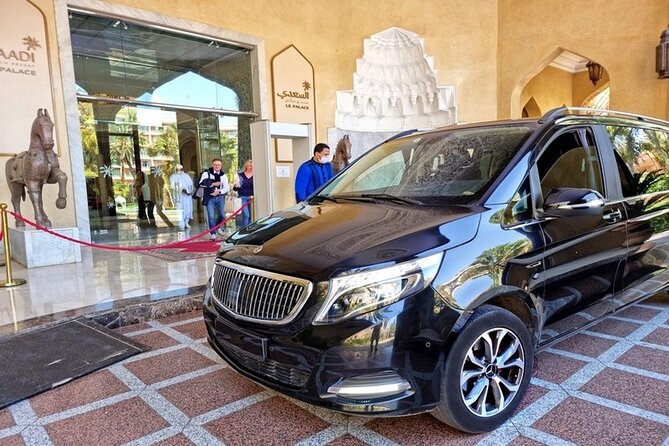
You are paying for more than sightseeing. You are paying for flow. Marrakech has traffic, narrow lanes, and sudden turns in the Medina, so having a private car ride you between clusters of attractions saves energy for the walking parts.
The tour uses a luxury Mercedes/Skoda vehicle, includes fuel surcharge, and comes with mini bottled water in the van. There is also hotel pickup and drop-off, but it depends on whether your lodging has vehicle access. If your riad is deep in the narrow maze, you may need to coordinate a nearby pickup spot that a driver can reach.
The itinerary is built like a loop. You start with a major Medina landmark, move through the older city gates and palace area, then shift into the markets and madrasas, and finally head to the gardens and French-era Gueliz. That sequence matters, because you see the city’s layers in a logical order rather than jumping back and forth all day.
More City Tours in Marrakech
- Marrakech: Private Guided Half-Day City Tour
★ 5.0 · 1,249 reviews - Marrakech Historical and Cultural Tour – Half Day City Tour
★ 4.5 · 1,180 reviews - Marrakech City Tour: Private Custom-Made
★ 4.5 · 596 reviews
Koutoubia Mosque: the skyline landmark that tells you where you are
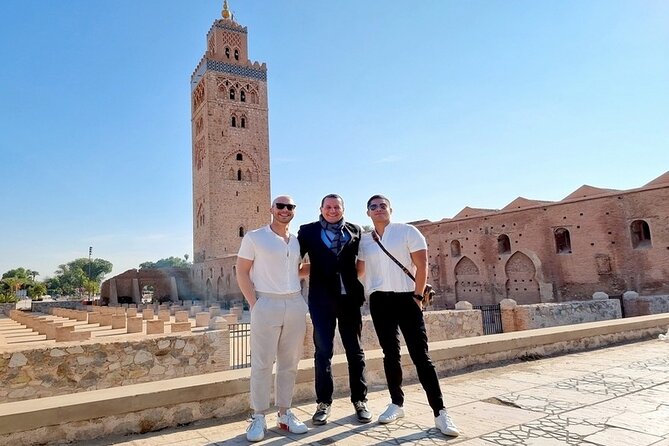
Koutoubia Mosque is one of those places where the exterior alone gives you instant orientation. The tour stops here first, and your guide shares what you are seeing: the mosque was founded in 1147 and it is Marrakech’s largest mosque. The minarets also have a reputation for influencing later buildings, including the Giralda in Seville and the Hassan Tower in Rabat.
The practical part: this is an easier start than beginning inside the Medina. You get a landmark that anchors your mental map. And because the stop is about 30 minutes and the admission ticket is marked free, it tends to be a smooth first block before the day’s walking picks up.
If you are sensitive to crowds or sun, this early stop is a good moment to reset. You are outside, but you still get the key context before you head into the tighter lanes later.
Bab Agnaou: seeing the old wall like a power portal
Next comes Bab Agnaou, one of Marrakech’s gates. It is part of the city ramparts, and the tour highlights that it dates to the Almohad Berber period in the 12th century. This gate is described as flanked by cannons and tied to the Caliphal Kasbah, the administrative and military complex.
A gate might sound like a quick photo stop, but it is one of the best places to understand how the city worked. Your guide can explain how these entrances were not just decorative. They were built to control movement toward centers of authority.
This stop is about 20 minutes and listed with free admission, so it is a short, efficient lesson in Marrakech’s defensive architecture.
Bahia Palace: when you pay to see craftsmanship up close
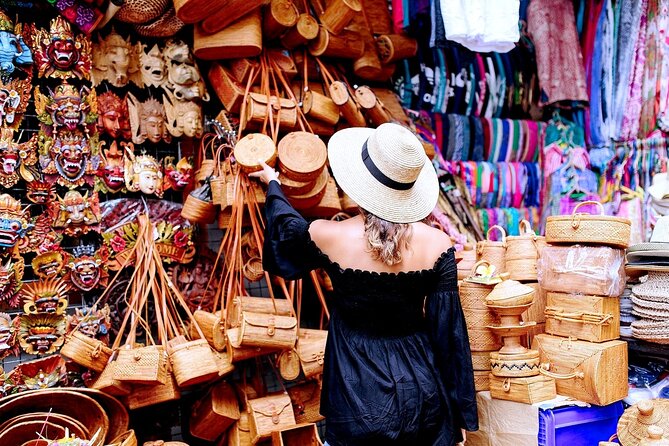
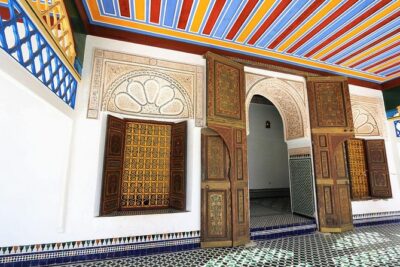
Bahia Palace is the stop where you feel why Marrakech is famous for detail. The palace is described as about 8,000 square meters and known for intricate marquetry, plasterwork, and painted wood ceilings called zouak. It is one of the city’s most eye-catching interiors.
The story helps. It was built by Grand Vizier Si Moussa in the 1860s, and the highlights are spread across several areas. The tour notes that both a Petit Riad and Grand Riad host ornate work, but the standout is the Cour d’Honneur, with a very large marble floor made from Italian Carrara.
One key reality to plan for: not all of the palace is open to the public. The palace covers a much bigger area and many rooms, but only a portion is accessible. That is not a downside, it is just how historic sites work. Your guide’s job is to point you to what is open and what matters most.
This stop is about 1 hour, and admission is not included, so budget separately if you want to go inside. I think this is worth it on a first trip because you leave with something tangible, not just street scenes.
Set these Marrakech options side by side
- Highlights of Marrakech: Private Half-Day City Tour
★ 5.0 · 478 reviews - Marrakech: Guided City and Gardens Highlights Tour
★ 3.4 · 446 reviews - Marrakech : Electric Bicycle City Tour
★ 4.8 · 363 reviews - Marrakech City Tour by Abdel : Morning & Afternoon Options
★ 5.0 · 332 reviews
Souk Semmarine: guided market time, with less stress and more good browsing
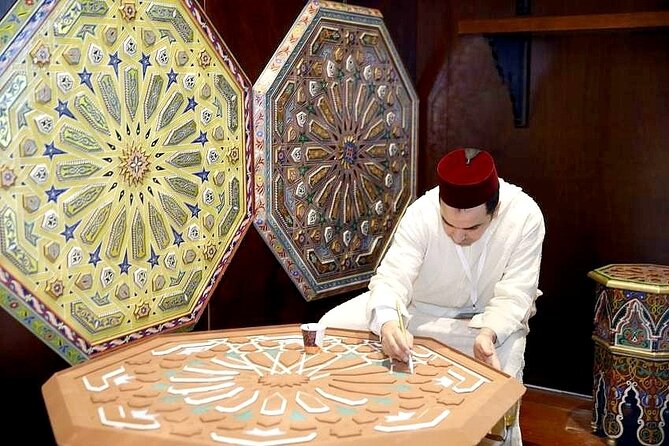
After lunch, the schedule shifts into the souks. Souk Semmarine is where the Medina turns into a sensory experience. The tour is designed for a long walking block, about 2 hours, following your guide through market lanes where you can smell spices, taste olives, touch leather goods, and buy local handicrafts.
This is the moment where a guide pays off most. Without one, it is easy to wander, spend money the wrong way, or miss the best passages. With one, you get a route through the market rhythm so you can enjoy it rather than fear getting lost.
A balanced tip: markets are also where sales pressure can happen. If you are shopping, decide your comfort level before you start. Let your guide lead the browsing and keep the shopping optional, not mandatory. The guide can also help you compare what you see at different stalls so you do not feel rushed.
Admission is listed as free for this part, so your biggest costs are what you choose to buy and what you decide to do at meal time.
Medersa Ben Youssef: one of the Medina’s best learning spaces
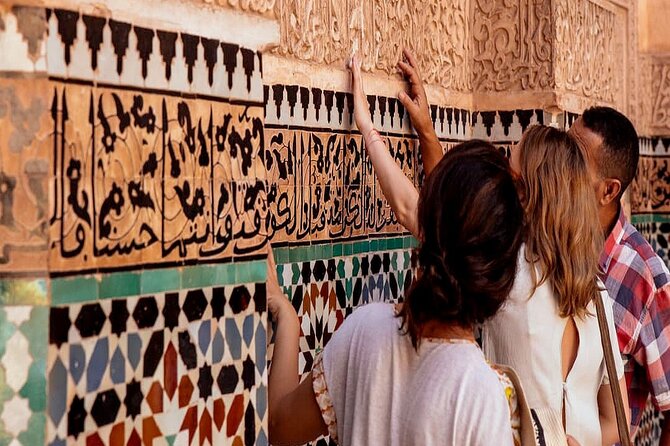
The Medersa Ben Youssef stop is a smart mid-day and early-afternoon reset because it is architecture and atmosphere, not just streets. The Ben Youssef Madrasa is described as the largest Koranic school of the Medina, still functioning today as a historical site. It also carried the weight of being the largest Islamic college in Morocco at its peak.
It is named after the adjacent Ben Youssef Mosque, founded by the Almoravid Sultan Ali ibn Yusuf, and the tour frames it as one of the best spots in the red city.
This stop is listed for about 40 minutes, with admission not included. I like how this fits between the loud souks and the bigger gardens. You go from street-level energy into a calmer kind of historic focus, and you notice how Moroccan design supports learning and movement.
If you enjoy Islamic art and architecture, this is one of the most meaningful parts of the day, because it gives you a quiet place where ornament actually has purpose.
Jemaa el-Fnaa: the square’s energy at a glance
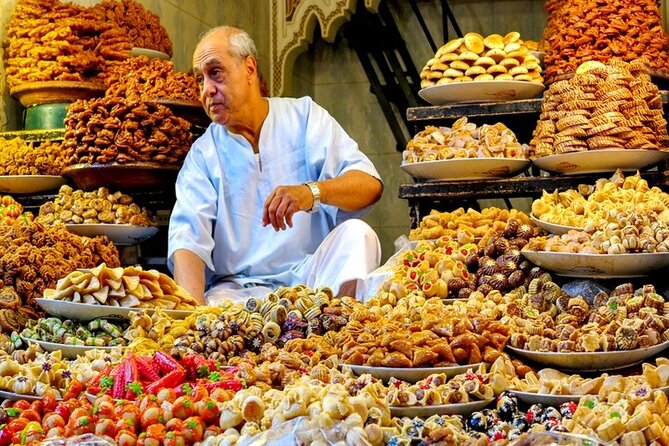
Jemaa el-Fnaa is the Marrakech square most people picture. The tour description calls out that from sunrise to sunset it comes alive with storytellers, acrobats, and street vendors. In the evening, it turns into an open-air dining hub with small stalls and local flavors.
In this itinerary, you have a shorter window, about 30 minutes, and it is described as a drive-by visit. That means you are not committing to the whole night scene, but you still get the sense of what makes this square the city’s heartbeat.
What you should do with that time: keep your expectations flexible. Sometimes it is dramatic and crowded, sometimes it is more relaxed. Either way, the value is seeing the scale of the place, understanding why it is the center, and knowing what you would want to return for later if you have more time in Marrakech.
Admission is listed as free, so again, your only decision is how much time you want to spend just watching and where you want to stand.
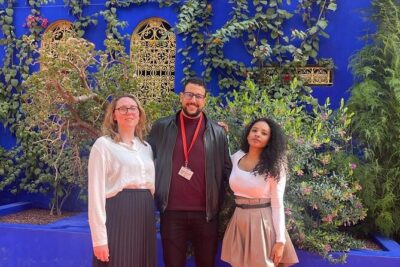
Jardin Majorelle and the Yves Saint Laurent area: color, art, and design logic
Then you switch worlds. The tour leaves the Medina for the Nouvelle Ville, where Jardin Majorelle is the anchor.
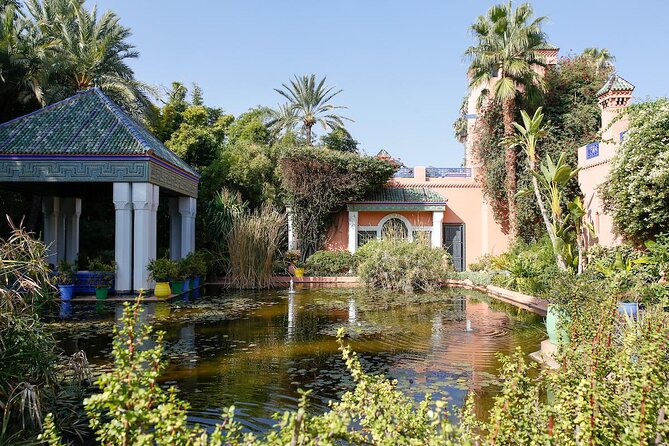
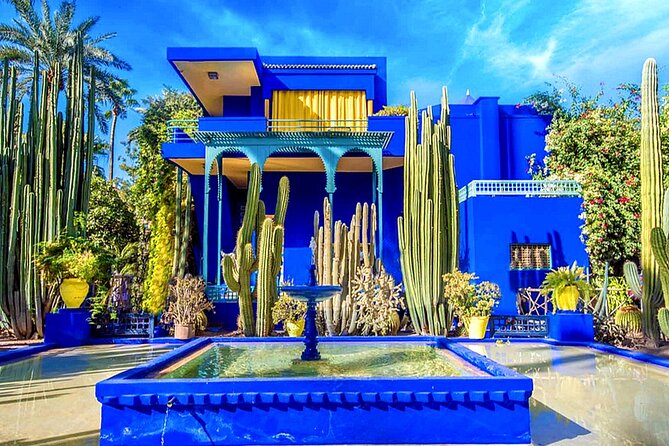
Jardin Majorelle was created by the French Orientalist artist Jacques Majorelle back in 1923, and it was opened to the public in 1947. The tour also points out a Cubist villa designed by the French architect Paul Sinoir in the 1930s. Even if you are not into garden design, the story is part of the draw because it links art movements to a very specific place in Marrakech.
This stop is about 40 minutes, and admission is not included. If you want a good return-on-time, plan to move at a walking pace. Look for the design choices, water features, and the way the garden frames views. This is one of the best “cool down” moments after hours in the heat and crowds.
The itinerary also schedules museums close by. One of the stops is the Berber Museum in the former painting studio of Jacques Majorelle, and the other is Musée Yves Saint Laurent Marrakech. Those two are great if you like culture that goes beyond monuments, fashion design, and visual storytelling.
Berber Museum and Musée Yves Saint Laurent: two different lenses near the gardens
The Berber Museum, inaugurated in 2011 under the High Patronage of King Mohammed VI, is described as housed in Majorelle’s former painting studio. The museum presents a panorama of Imazighen, the Berbers of North Africa, using a large collection.
The tour notes more than 600 objects collected from the Rif Mountains to the Sahara by Pierre Bergé and Yves Saint Laurent. The emphasis here is not just on artifacts, it is on showing creativity that is still alive today.
This stop is about 30 minutes and admission is not included. It is short enough that you do not feel stuck, but long enough to spot themes, especially if your guide takes a minute to orient you before you start walking.
Next is Musée Yves Saint Laurent Marrakech. It opened in autumn 2017 and houses a selection from the Fondation Pierre Bergé and Yves Saint Laurent collection, including 5,000 items of clothing, 15,000 haute couture accessories, and tens of thousands of sketches and assorted objects.
The building design is listed as by Studio KO, founded by architects Olivier Marty and Karl Fournier. The museum spans over 4,000 square meters, with about 400 square meters dedicated to the permanent exhibition.
This stop is also about 30 minutes, and admission is not included. If fashion is your thing, you will likely want more time, but on a full-day tour this is still a strong hit. If fashion is not your thing, you can still enjoy the chance to see how design and architecture work together in this part of town.
Gueliz drive-through: getting the French-era contrast without losing the day
Finally, you get a drive through Gueliz, Marrakech’s modern side. The tour calls it the heart of the newer part of the city, with main avenues Mohammed VI and Mohammed V linking the Old Medina with Gueliz.
This is where you see the French-era street layout and the modern rhythm: upscale Moroccan and European restaurants, art galleries, mainstream fashion stores, and a more international feel. The tour even lists brand examples such as Zara, Diesel, Louis Vuitton, and H&M.
This stop is about 20 minutes, with free admission. Think of it as a moving overview, not a deep neighborhood walk. I like it for first-time visitors because it helps you understand where people live and shop outside the Medina, and it gives you ideas for where to return later at your own pace.
Price and value: what you are really buying at about $70.88 per person
At $70.88 per person for a roughly 7 hour 30 minute private tour, you are not paying for entry tickets. You are paying for a private guide plus private vehicle time for an entire day, including fuel surcharge and hotel pickup and drop-off.
That value equation gets better if you plan to do multiple paid interiors. In this route, several major sites are marked as not included for admission: Bahia Palace, Medersa Ben Youssef, Jardin Majorelle, the Berber Museum, and Musée Yves Saint Laurent. Koutoubia Mosque and Bab Agnaou are marked as free, and the souk and Jemaa el-Fnaa parts are listed as free too, but those do not replace paying for the iconic interiors.
Also note the schedule is packed but not random. You spend a lot of your time in different “clusters”: Medina monuments, then Medina markets, then the Majorelle museum zone, then a modern streets overview. That keeps transport costs under control and prevents your day from collapsing into waiting.
If you like structure and want to see a lot without stressful navigation, this is a strong deal. If you mainly want slow wandering, you might prefer building your own Medina route so you can linger where the mood hits.
Who this tour fits best, and who may want a different plan
This private tour works best if you:
- want a full-day introduction that hits both the Medina and newer Marrakech
- want a guide to make the Medina easier to navigate, especially in Souk Semmarine
- prefer comfortable transportation between sites
- like context and architectural details, not just photos
It might be less ideal if you:
- only want free outdoor sights, since many of the marquee stops require separate entry fees
- dislike being on a fixed schedule for a long day
- want a deep museum experience where you can spend an unhurried hour or two inside each gallery, rather than the shorter time blocks here
A quick honesty checklist for your day
- Wear comfortable shoes, because the market stop is a long walk.
- Bring cash or cards for entrances and shopping, since admissions are not included.
- Expect your guide to set the pace. This tour is designed to keep moving.
- If you care about specific museum timing, plan to check opening days before you commit, since admissions are separate and museum time matters.
Should you book this Marrakech private city tour?
I would book it if you want a first-trip overview with smart routing, comfort, and a real guide who can explain what you are seeing. The standout value is the combination of private van transport and guide-led Medina wandering, then a strong shift to Jardin Majorelle and the museum area near it.
Do it with your eyes open on admissions. Your cost will rise if you go into Bahia Palace, Medersa Ben Youssef, Jardin Majorelle, and both museums, but that is also the trade you are making for a day packed with “inside” sights.
If you only want a light taste of Marrakech and you hate paying separate entry fees, then consider a shorter half-day or a more focused plan. For most people doing Marrakech in one go, this long private day is a practical, high-return way to get oriented fast.
FAQ
How long is the Marrakech city tour?
It runs for about 7 hours 30 minutes.
Is this tour private?
Yes. It is a private tour/activity, and only your group participates.
What places are included in the itinerary?
The day includes stops at Koutoubia Mosque, Bab Agnaou, Bahia Palace, Souk Semmarine, Medersa Ben Youssef, Jemaa el-Fnaa, Jardin Majorelle, and nearby museum stops in the same area, plus a drive through Gueliz.
Are monument entrance fees included?
No. Admission fees to monuments are not included.
Does the tour include pickup from hotels?
Yes. Hotel pickup and drop-off are included, as long as your accommodation has vehicle access.
What kind of vehicle is used?
You travel in a private luxury vehicle, described as a Mercedes or Skoda, and the tour includes a driver.
Is bottled water provided?
Yes. There is mini bottled water included in the van.
Is the guide available in English?
The tour includes an expert licensed official guide and an expert English-speaking driver.
Where does the tour start and end?
The activity starts at Rue des Banques, Marrakech 40000, Morocco, and ends back at the meeting point.
Is free cancellation available?
Yes. You can cancel up to 24 hours in advance for a full refund.
Just reviewed around Marrakech
- From Marrakech: Day trip to Ouzoud waterfalls and boat tour★ 5.0 · 73 reviews
- Private horseback ride in the Palmeraie of Marrakech★ 5.0 · 73 reviews
- Marrakech to Essaouira / Small group day tour To Essaouira★ 5.0 · 73 reviews
- 1 Day Guided Tour of World Heritage Kasbah Ait Ben Haddou from Marrakech★ 3.5 · 73 reviews
- Marrakech: Authentic Local Dinner with Transport★ 4.1 · 73 reviews
- Ourika Valley Day trip: Hike, waterfall, lunch and Relax★ 4.8 · 73 reviews
- Waterfalls, Three valleys, Atlas Montains, Camels & Desert★ 5.0 · 73 reviews
- Marrakech: Cycling Tour in Palm Groove with Local Breakfast★ 4.7 · 73 reviews
City Tours, compared.
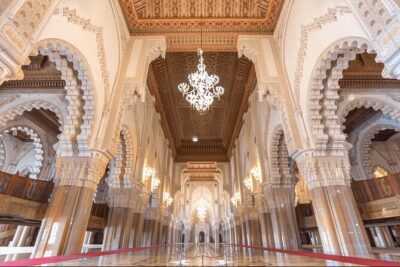
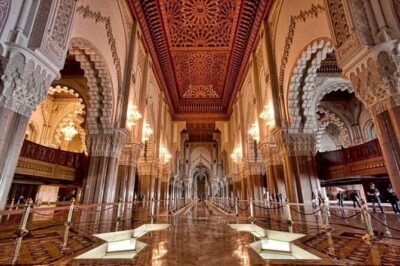
Casablanca City Tour with Hassan II mosque ticket
Read our review →
Blue City magic: Affordable Day Trip from Fez to Chefchaouen
Read our review →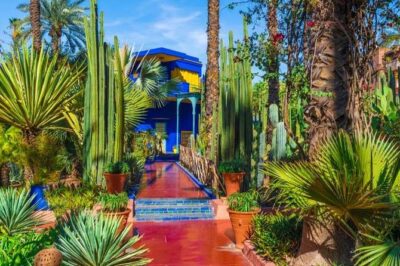
Marrakech Historical and Cultural Tour – Half Day City Tour
Read our review →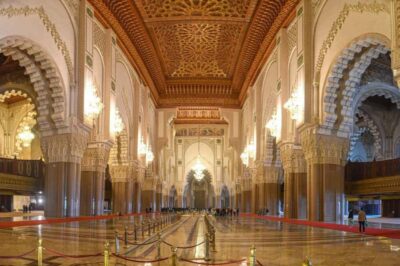
Browse the lists this tour appears in